
Why these rows exist at all
In a large part of India, the first thing that happens after two biodatas are exchanged is that somebody takes them to an astrologer. Matching horoscopes before meeting saves both families a conversation that was never going to go anywhere, and the rows below are the details that matching needs.
If your family does not do this, none of it applies and you should leave every one of these rows out. An empty row labelled Gotra looks worse on a page than no row at all.
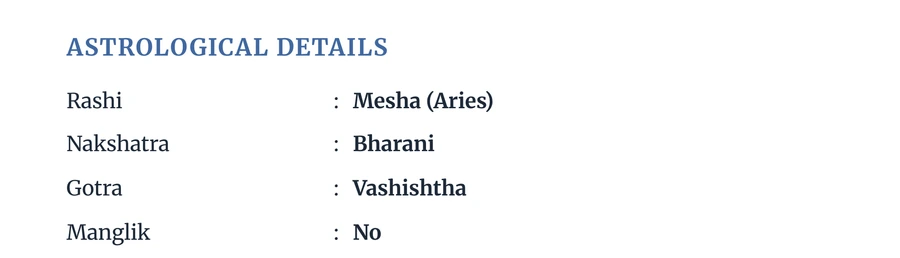
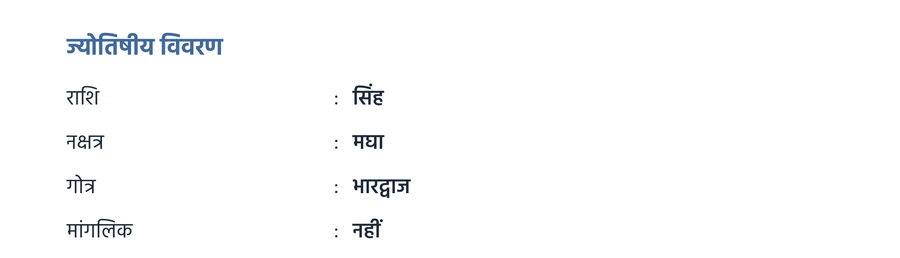
Rashi — your moon sign
Rashi is the zodiac sign the moon was in when you were born. It is not the same as the sun sign you read in a newspaper, and the two are often different, so do not guess from your birthday.
It comes from your birth chart. If your family had one made when you were born, it is on there. If not, an astrologer can work it out from your date, time and place of birth in a few minutes.
Nakshatra — your birth star
There are twenty-seven nakshatras, and yours is decided by where the moon sat within your rashi. It is the finer measurement of the two, and it is what most matching actually turns on.
Rashi and nakshatra come from the same chart, so if you have one you have the other. Put both or neither — a rashi on its own is not much use to whoever is doing the matching.
Gotra — your paternal lineage
Gotra traces your father's line back to an ancestral sage. Many communities avoid matches within the same gotra, which is the only reason it appears on a biodata at all.
You will not find it on a document. Ask your father or grandfather — this is the kind of thing the oldest person in the family knows without having to look it up.
Manglik — a yes or a no
Manglik describes a particular placement of Mars in the birth chart. Some families ask about it before they ask anything else; plenty of families never raise it.
It is one word on the page. If it matters to the families you are sending this to, put it in and save everybody a phone call. If it does not, leave it out.
How to decide what goes on your page
The honest test is not what tradition says — it is who is going to read this. If the biodata is going to families who match horoscopes, include everything you have and include it accurately. If it is going to families who do not, these four rows are taking up space that your education and your family details could use better.
You can always keep a version with them and a version without. It is the same form either way.
Related articles
Choosing the Right Photo for Your Marriage Biodata
A photograph often shapes the first impression of a biodata. Here is how to pick one that feels clear, current and natural.
Read moreMarriage Biodata Dos and Don'ts: What Families Notice First
The format guide covers what goes in each section. This covers how to write it so it reads well — and the handful of mistakes that come up again and again.
Read moreThe First Meeting: What to Talk About
The biodata did its job and a meeting is arranged. Here is what people actually talk about in that first half hour, and the questions worth asking early.
Read moreMarriage Biodata for a Boy and for a Girl
Two different searches, two sets of templates, and one document. What genuinely differs between a boy's biodata and a girl's — and what does not.
Read more