Marriage biodata format
A good marriage biodata — or shaadi biodata — is easy to understand at a glance. This guide explains what each section is for, what families commonly include, and what you can leave out.
- 11
- Languages
- 9
- Community formats
- A4
- Ready to print
What goes in each section
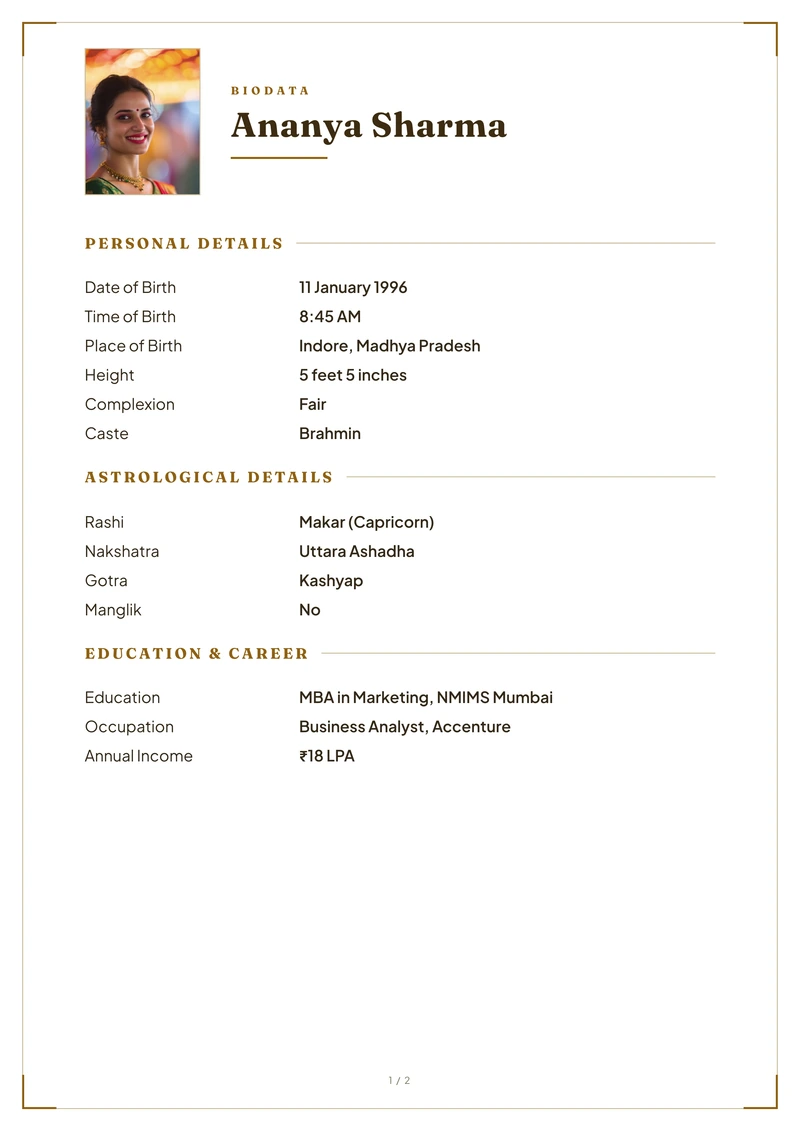
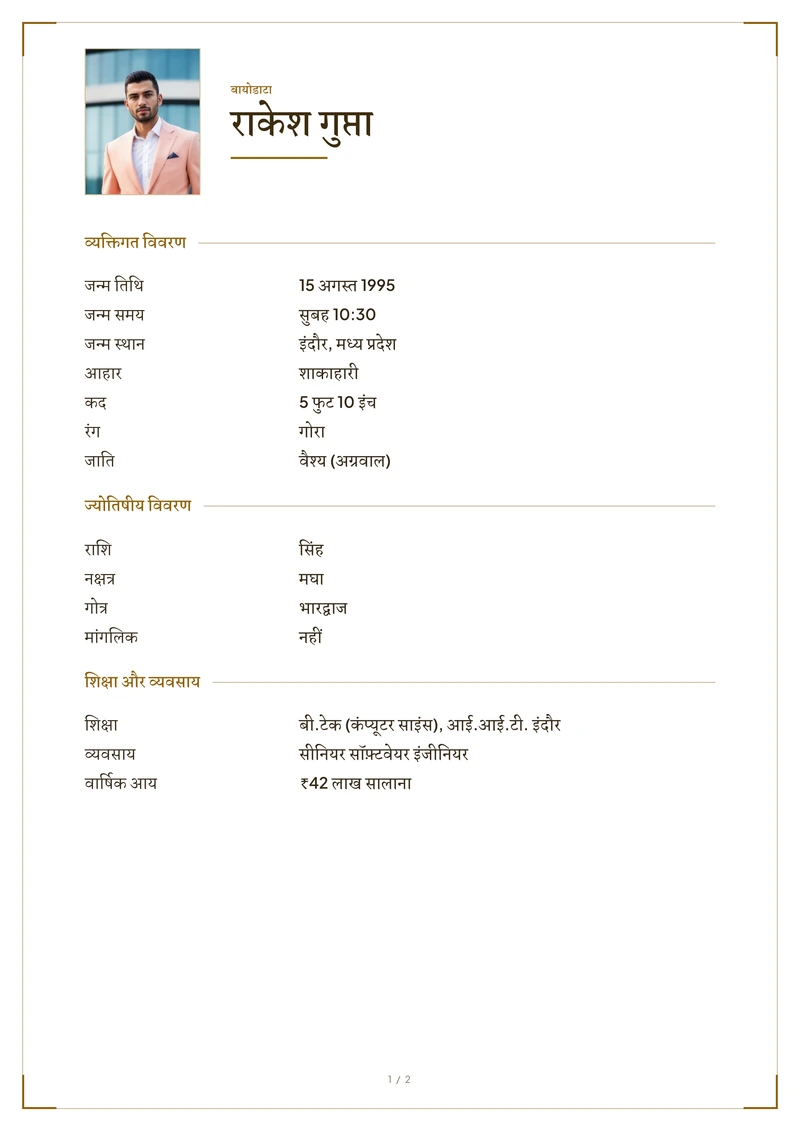
Every row, why families ask for it, and what a filled-in one looks like — beside a real biodata you can read as you go.
What a good marriage biodata has
- A clear, recent photograph where your face is easy to see, if you choose to include one
- Your name spelled exactly as it is on your documents
- Clear sections — personal, education, family, contact, and the horoscope rows if you use them
- Only the rows your family actually uses — an empty row looks worse than no row
- Contact details you have checked twice
- Short enough to read in one go — most run to two or three pages
The part everyone reads first, and usually the only part they read closely.
1. Name
Always write your full name, spelled the way it appears on your documents. It is the first thing anyone sees and the thing they will repeat to other families.
For example: Rakesh Gupta
2. Date of Birth
Families look at this straight after the name, and it is what horoscope matching starts from. Write it out in full rather than in numbers, so nobody has to guess the order.
For example: 15 August 1995
3. Time and Place of Birth
Only needed if your family matches horoscopes — but if they do, an approximate time is not much use. Take it from your birth certificate if you can.
For example: 10:30 AM · Indore, Madhya Pradesh
4. Height and Complexion
Commonly asked in Indian biodatas. Write height in feet and inches, the way it will be read aloud.
For example: 5 feet 10 inches · Fair
5. Hobbies and Interests
The one place a biodata stops being a form and sounds like a person. Two or three real interests do more than a long list.
For example: Cricket, trekking, cooking on weekends
Keep it short. Two lines will do more than a full CV.
1. Education
Your highest qualification and where you studied. One line is enough — this is a biodata, not a job application.
For example: B.Tech in Computer Science, IIT Indore
2. Occupation
What you do and where. If you are self-employed or run a family business, say so plainly — it is a normal and respected answer.
For example: Senior Software Engineer, Google
3. Annual Income
Optional, and plenty of families leave it off. Include it if you would rather answer it once here than be asked every time.
For example: ₹42 LPA
In an arranged match, two families are being introduced, not just two people.
1. Father's and Mother's Name and Occupation
This tells people where you come from, which in many families matters as much as anything above it. Retired is a perfectly good answer.
For example: Sh. Rajesh Gupta, Business (Steel Trading) · Smt. Sunita Gupta, Homemaker
2. Siblings
How many, and whether they are married. Elders often compare several biodatas at once and this is the detail that keeps yours straight in their minds.
For example: One brother (married), one sister (unmarried)
3. Native Place and Family Type
Where your family is originally from, and whether you live jointly or as a nuclear family. Both come up early in conversations.
For example: Indore, Madhya Pradesh · Joint family
The whole point of the document. Check these twice.
1. Contact Person
In most families this is a parent rather than the person the biodata is about. Say who it is, so whoever calls knows who they are speaking to.
For example: Sh. Rajesh Gupta (Father)
2. Phone and Email
A number that is actually answered. This is where a serious enquiry arrives, and a typo here quietly costs you every match on the page.
For example: +91 90000 XXXXX · rakesh.gupta@example.com
3. Residential Address
City and state is enough for most families. A full address is normal too — put in as much as you are comfortable sharing.
For example: Palasia Square, Indore, Madhya Pradesh
The form does not start with these. Picking a Community adds the horoscope rows that set carries, and any one of them can be added by hand from any starting point.
1. Rashi and Nakshatra
Your moon sign and birth star. Families who match horoscopes will ask for both, and leaving them out means a phone call later.
For example: Simha (Leo) · Magha
2. Gotra
Your ancestral lineage. It matters in communities that avoid matches within the same gotra. If it is not part of your tradition, leave it out.
For example: Bharadwaj
3. Manglik
A yes or a no. Some families ask before anything else; others never mention it. Only include it if it is relevant to yours.
For example: No
4. Religion, Caste and Mother Tongue
Some families put all three, some put none. There is no right answer — put in what the families you are sending this to will expect.
For example: Hindu · Brahmin · Hindi
One last tip
Do not try to fill every row. The best biodatas we see are short, honest and easy to read in one go — a page somebody can glance at, understand, and pass on to the next family without having to explain anything.
Free resources
To read, to open, and to look at before you make your own. All free, no signup.
- Finished examplesSix complete biodatas in four languages, each with its PDF to open.
- Every row, explainedWhat goes into a biodata, group by group, with the labels in Hindi and Marathi.
- How to make oneWhat to keep ready, the three steps, and what to check before you send it.
- Free Word formatsA blank .docx for every community set, and General in Hindi and Marathi.
- The PDF, explainedWhat print-ready means, the sample PDFs, and what the download costs.
- The free Basic designThe plain sheet: same rows, same eleven languages, downloads free.
By situation
The same sheet, written for the case you are in.
Formats by community
The same document, with the rows each family actually prints — nakh and samaj on a Gujarati sheet, devak on a Maharashtrian one, the nanihal on a Marwari one.
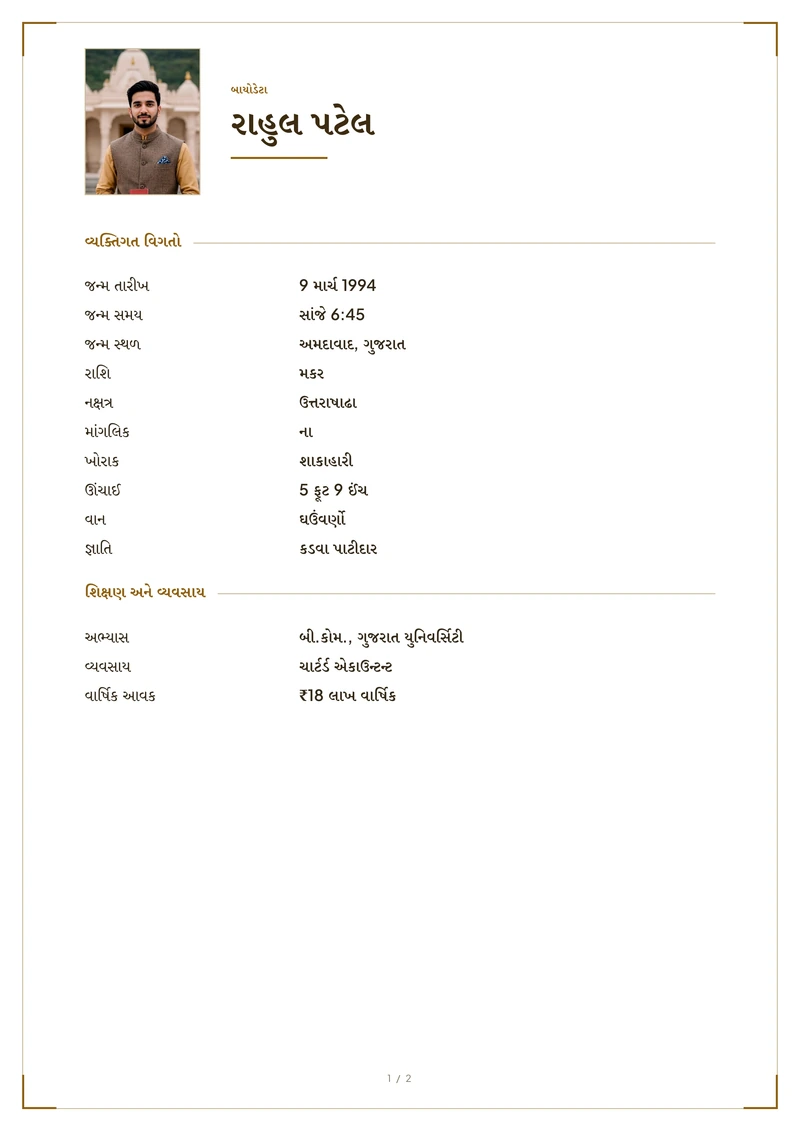
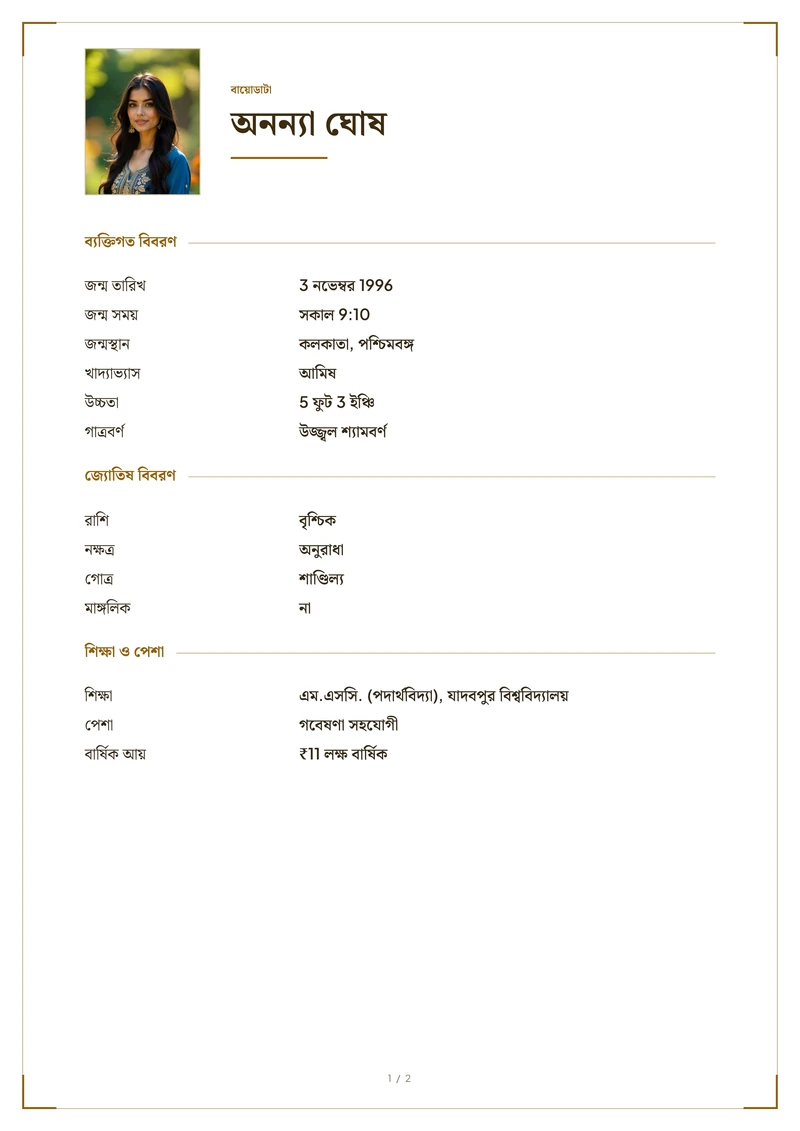
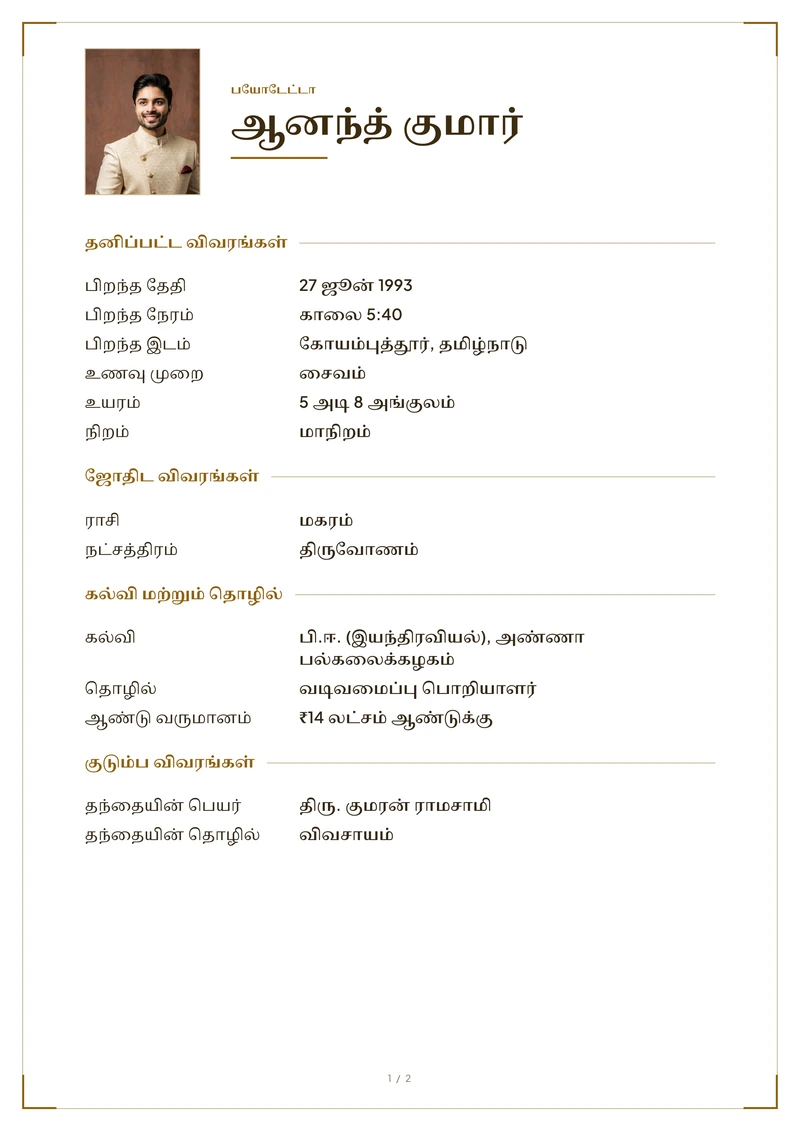
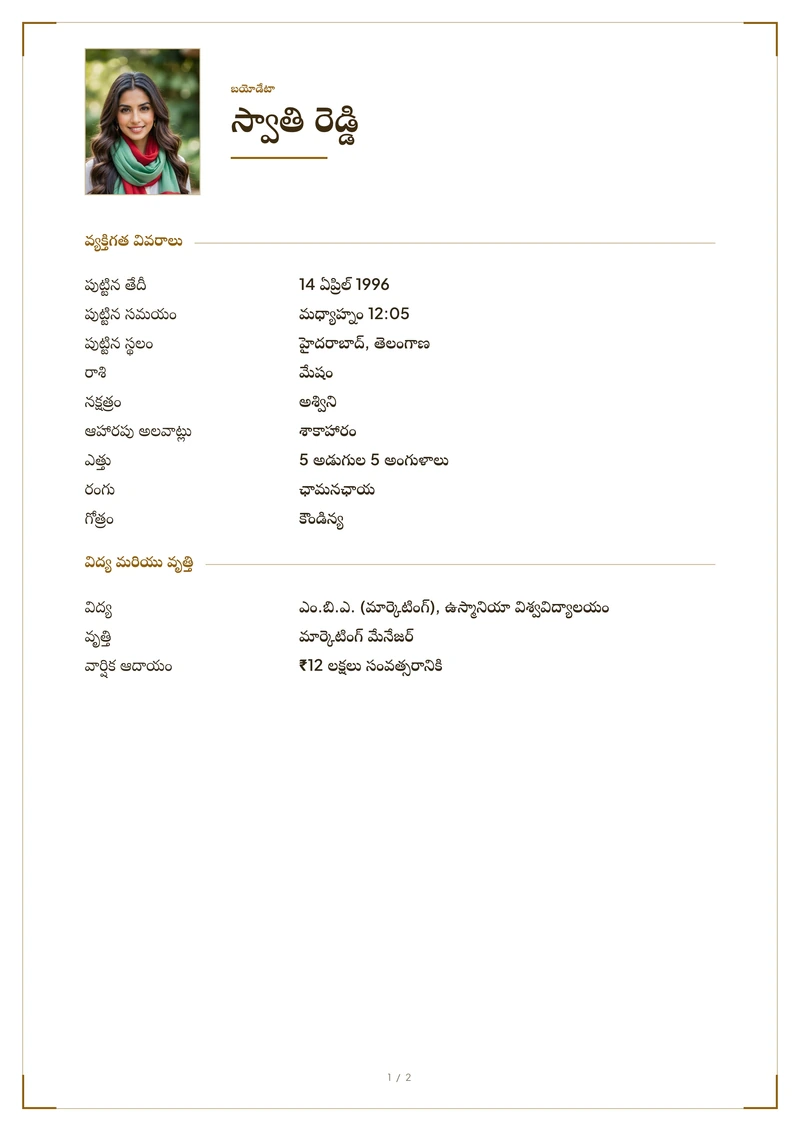
The same format, in 11 languages
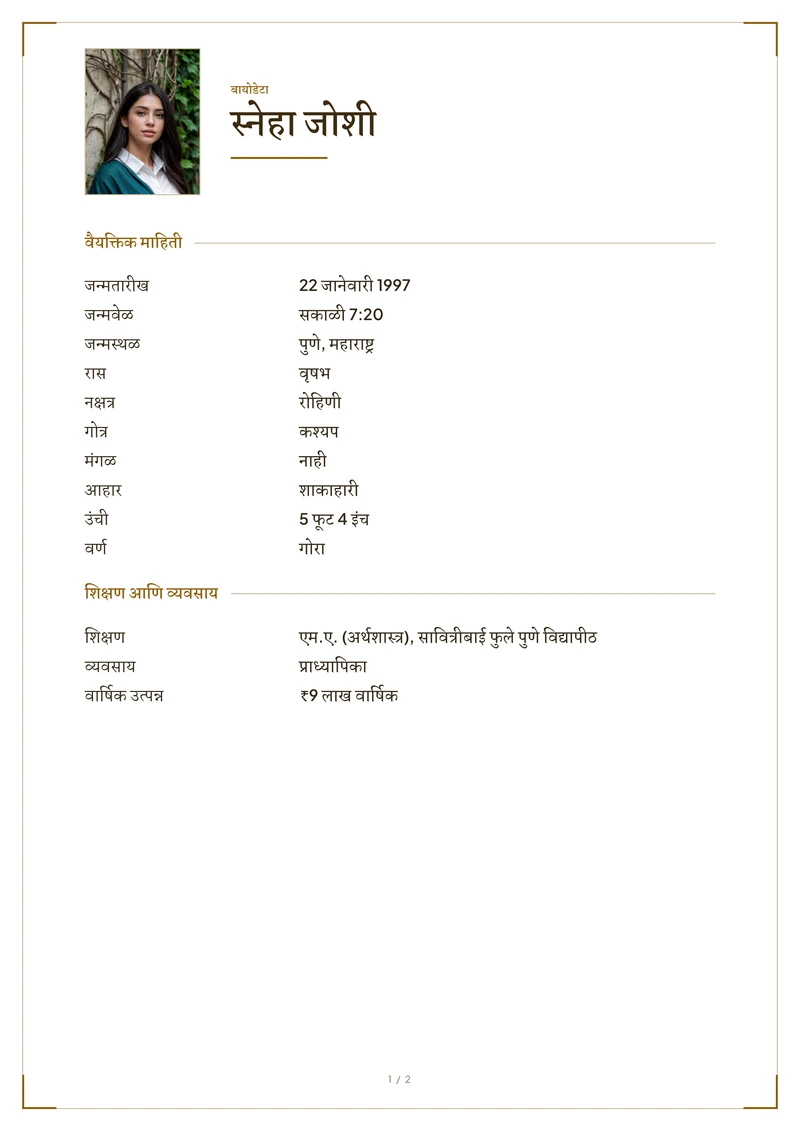
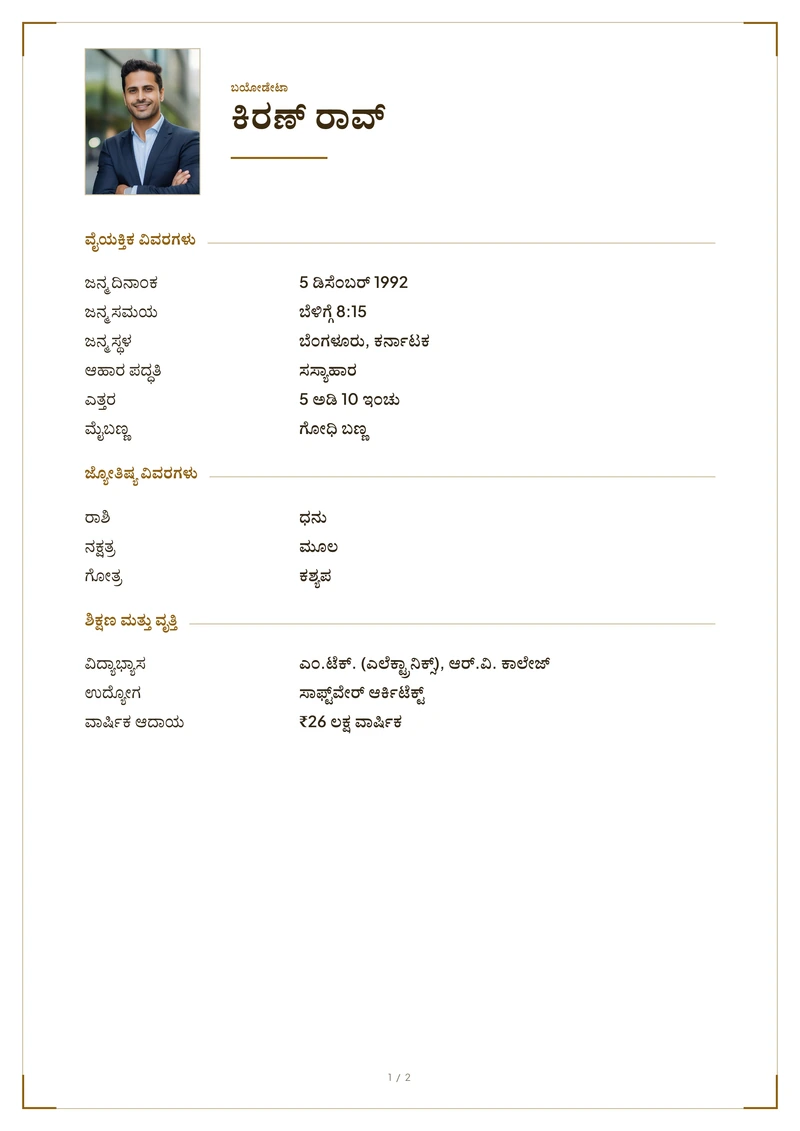
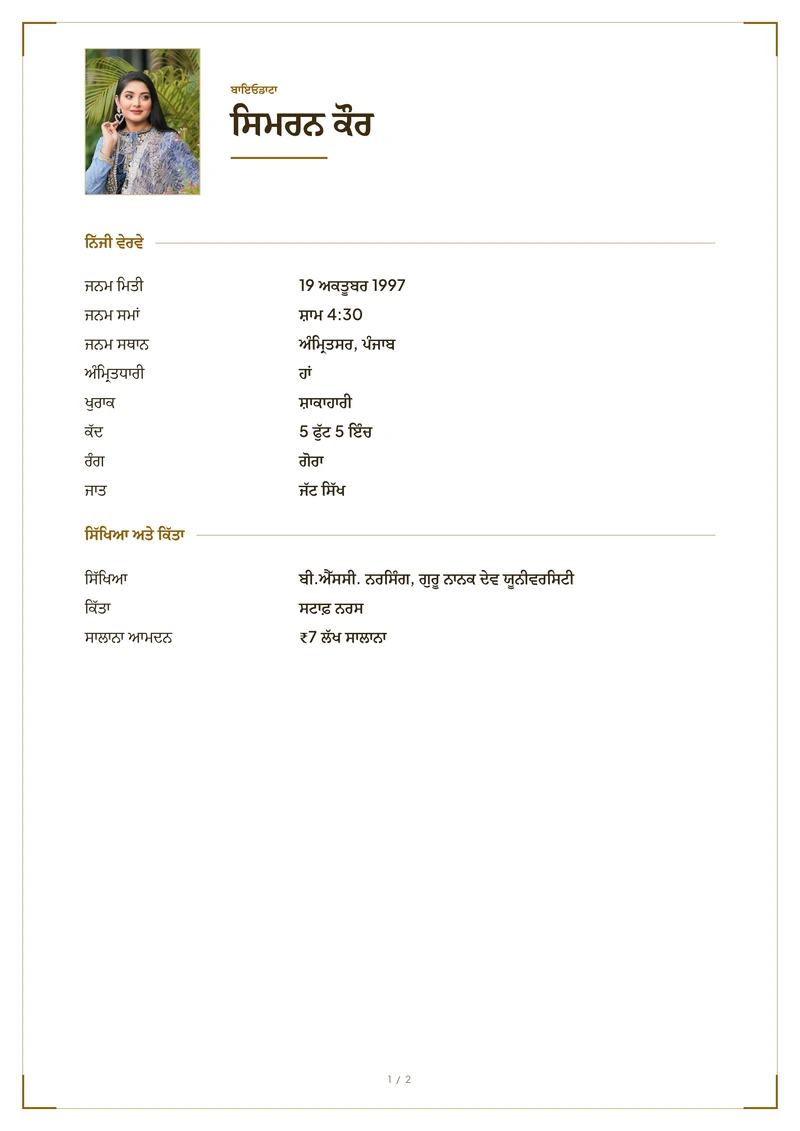
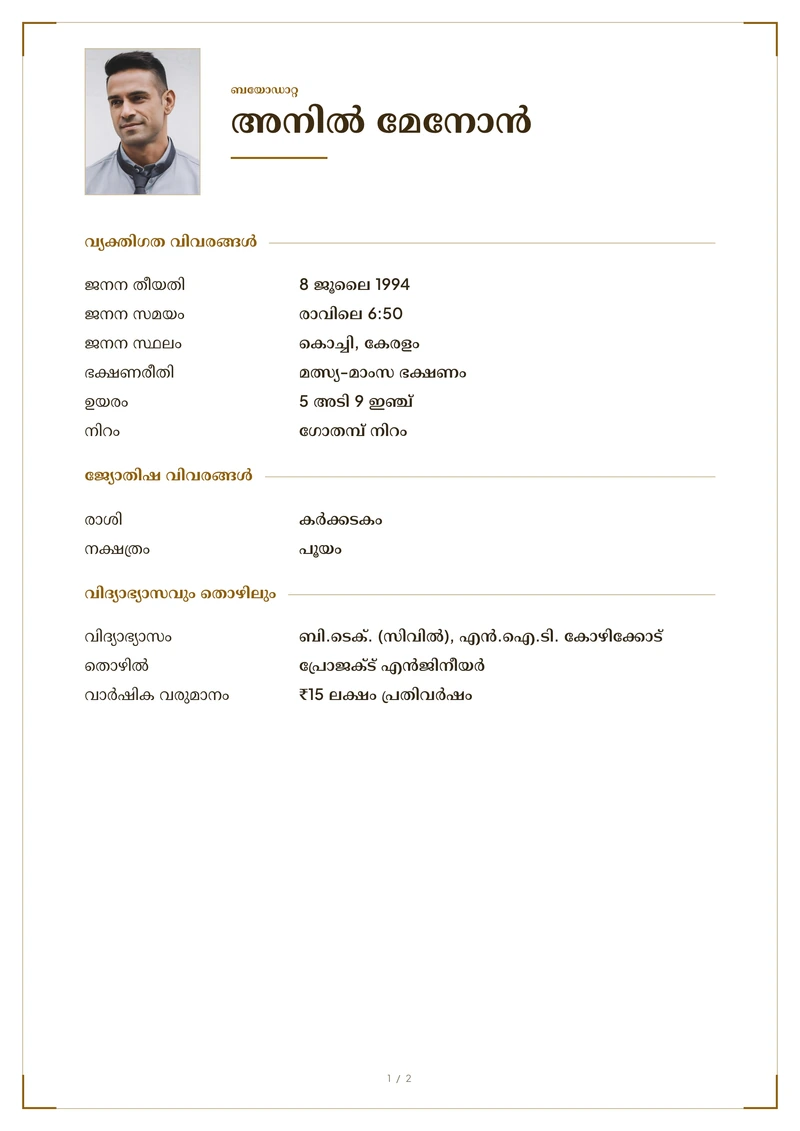
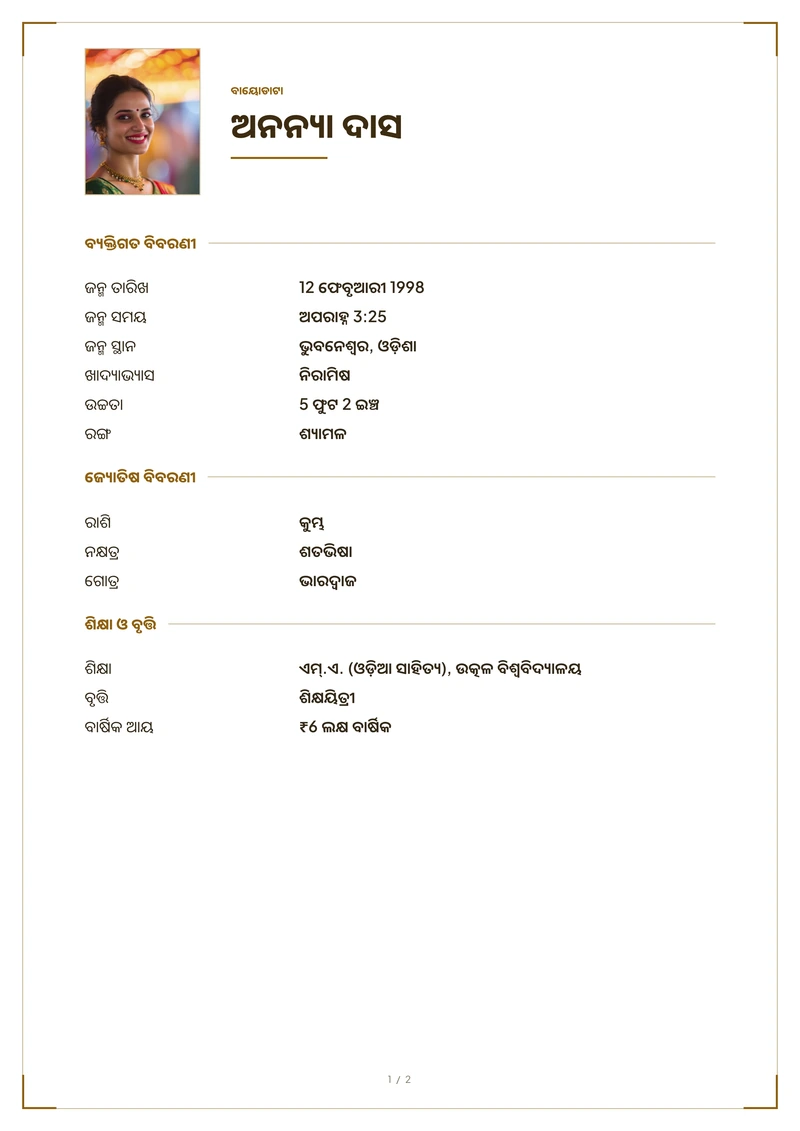
Each page has the complete label set written in that script, and a finished A4 sample typeset in it — not a translation of this page.
Questions people ask
- How long should a marriage biodata be?
- One page, or two if the family section is large. Beyond that it stops being scanned and starts being skimmed. A cover page with the photo and name, then one page of details, is the shape most families expect.
- Which fields are compulsory?
- Nothing is compulsory to a family reading it, but a biodata is expected to carry a name, date of birth, education, occupation, family details and a contact number — leave one out and you will be asked for it. Everything else — rashi, gotra, manglik, complexion, income — belongs there only if your family uses it. The form itself only insists on a name and one other detail; the rest it suggests and lets you skip.
- Should the biodata be in English or in my own language?
- Whichever your family reads. English travels further between families who do not share a script; a biodata in Hindi, Marathi or Tamil reads more naturally to relatives who do. Many people make both — the same details, printed twice.
- Does a biodata need a horoscope?
- Not the full horoscope, but the details it is cast from — date, time and place of birth — are worth including if your family matches horoscopes. South Indian biodata often go further and list nakshatra, rasi and lagnam directly.
Or fill it in and let the layout sort itself out
One form, 34 designs, and a clean A4 PDF at the end. Previewing costs nothing.
Preview costs nothing. The price is shown before you pay.